A calm, science-aligned nighttime routine using journaling, breathwork, and mindfulness to slow racing thoughts and make sleep feel possible again.
The Rest Pact
Updated October 18, 2026
Created October 18, 2026
Progressive Muscle Relaxation for Sleep

Maya Caldwell
Maya Caldwell is a certified sleep science coach and the lead researcher at RestPact. After overcoming years of chronic insomnia, she dedicated herself to making evidence-based sleep strategies accessible, helping others build bedtime routines that lead to deep, restorative rest.
If your brain is tired but your body feels like it is still “on,” you are not imagining it. Stress often shows up as physical tension first: clenched jaw, tight shoulders, a guarded belly, toes curled like you are bracing for bad news. Progressive Muscle Relaxation (PMR) is one of my favorite tools for that exact problem because it gives your nervous system something concrete to do: tense, then release.
PMR is not a mindset trick. It is a body-based technique that teaches you to recognize tension and let it go on purpose. Done consistently, it can become a reliable bridge from “still in the day” to “ready for sleep.”
What PMR is and why it helps sleep
Progressive Muscle Relaxation is a structured method of tightening a muscle group for a few seconds, then releasing it fully, moving through the body in a sequence. It is commonly credited to physician Edmund Jacobson, whose foundational work was published in the 1920s and 1930s, based on the idea that mental calm is easier when the body is not holding tension.
From a sleep perspective, PMR can help with two common insomnia drivers:
- Somatic hyperarousal: the “wired body” feeling where your muscles, breath, and heart rate do not seem to get the memo that it is bedtime.
- Attention stuck on discomfort: the more you notice tightness, the more you scan for it, and the more awake you feel. PMR replaces that loop with a predictable, soothing script.
Research on relaxation training, including PMR, suggests it can lead to modest improvements in insomnia symptoms for some people, especially when stress and anxiety are part of the picture. PMR is also often used as an option within CBT-I (cognitive behavioral therapy for insomnia) programs as a downshift tool, even though not every CBT-I protocol includes PMR specifically.
The science in plain English
From “threat mode” to “rest mode”
When you are stressed, your sympathetic nervous system ramps up: muscle tone increases, breathing gets shallower, and you become more sensitive to sensation. PMR creates a contrast between tension and release, which can:
- Lower muscle activation across the body over time
- Encourage slower breathing during the release phase for many people
- Shift attention away from rumination and toward physical cues of calm
It trains body awareness
In plain terms, PMR helps you notice what is happening inside your body without getting pulled into a spiral about it. Many people with insomnia are either hyper-focused on symptoms (“Why is my heart pounding?”) or disconnected until the tension is extreme (“I did not realize my shoulders were up by my ears”). PMR trains a more useful middle ground: noticing sensation, then letting it change.
It can become a sleep cue
When you practice PMR in the same context, such as after lights out, your brain can begin to associate the sequence with winding down. Think of it as building a new bedtime reflex.
How to do PMR for sleep
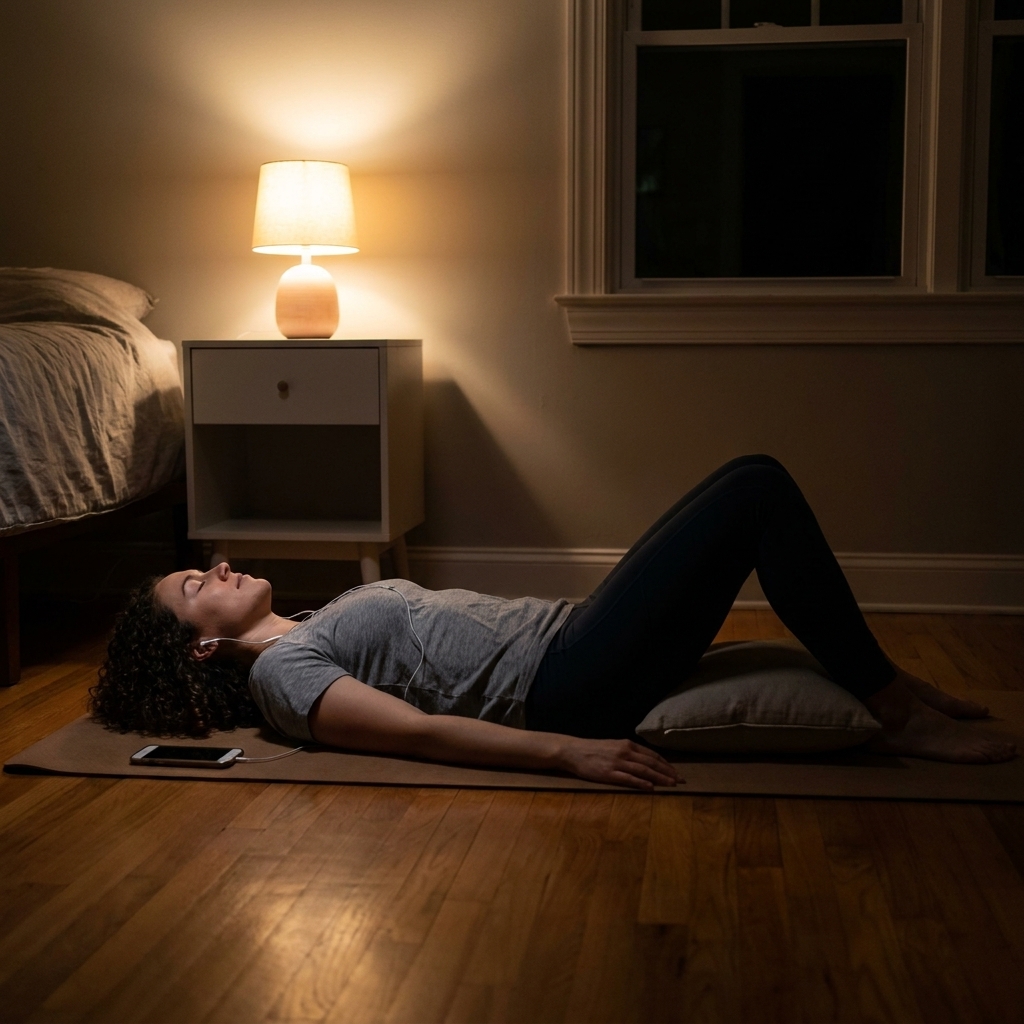
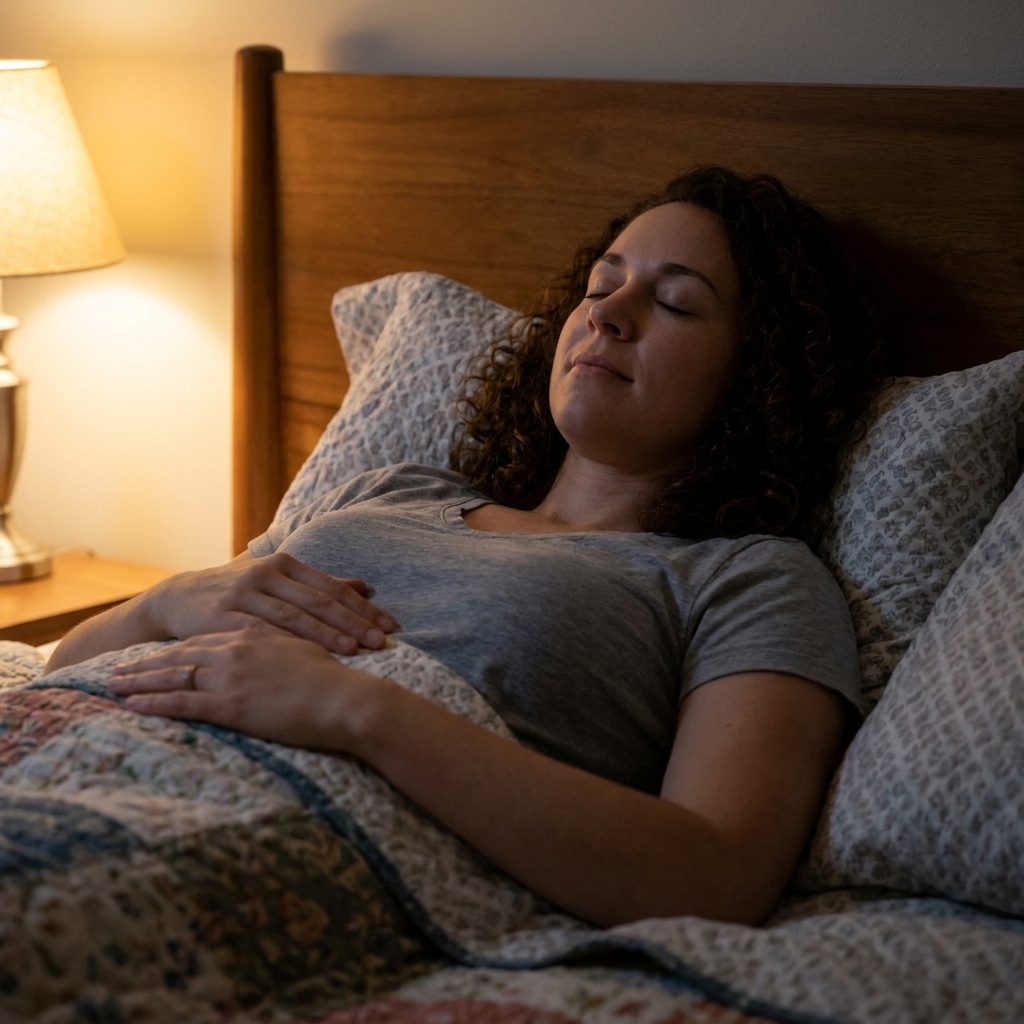
You can do PMR lying in bed, on a yoga mat, or reclined on a couch. If you are using it specifically for sleep, I prefer doing it after you are done with phone scrolling and bright lights, when the room is already dim.
Quick setup
- Position: Lie on your back or side with your jaw relaxed and shoulders heavy.
- Intensity: Tense at about 30 to 50 percent of your max. This is not a workout.
- Timing: Tense for 5 to 7 seconds, then release for 15 to 25 seconds.
- Breath: Inhale as you tense, exhale as you release if it feels natural. Do not force it.
Full-body sequence (10 to 15 minutes)
Move through these steps slowly. You are practicing the contrast between “braced” and “soft,” not trying to do it perfectly.
- Hands: Gently make fists. Hold. Release and let the fingers soften.
- Forearms: Bend your wrists slightly back like you are pulling your knuckles toward your face. Hold. Release.
- Upper arms: Lightly flex biceps by bending elbows. Hold. Release, letting arms feel heavy.
- Shoulders: Shrug shoulders up toward ears. Hold. Release and let them drop.
- Face: Raise eyebrows or scrunch forehead. Hold. Release. Then lightly squeeze eyes shut. Hold. Release.
- Jaw: Let teeth come close without clenching, or press your tongue gently to the roof of your mouth. Hold. Release, letting lips part slightly.
- Neck: If it feels comfortable, press the back of your head softly into the pillow. Otherwise, skip the effort and simply notice your neck muscles soften on the release.
- Chest: Take a slightly bigger inhale, expanding the chest. Hold for a moment. Exhale and soften.
- Stomach: Pull belly in gently like bracing. Hold. Release and let the abdomen expand with the next breath.
- Lower back and glutes: Squeeze glutes lightly. Hold. Release.
- Thighs: Press legs down into the mattress or tighten thighs. Hold. Release.
- Calves: Point toes away slightly. Hold. Release.
- Feet: Curl toes. Hold. Release and let feet fall into a neutral, loose position.
When you finish, stay still for 30 to 60 seconds and notice the after-effect: warmth, heaviness, slower breath. If your mind starts problem-solving, gently return to the sensation of contact points with the bed.

3-minute PMR
Some nights, the idea of a 15-minute routine feels like too much. This is the short version I use when I am exhausted but still tense.
- Shoulders: Shrug up for 5 seconds, release for 15 seconds.
- Jaw: Bring teeth close without clenching for 5 seconds, release for 20 seconds.
- Hands: Make fists for 5 seconds, release for 20 seconds.
- Thighs and glutes together: Light squeeze for 5 seconds, release for 25 seconds.
- Feet: Curl toes for 5 seconds, release for 25 seconds.
If you only do one thing, make the release phase longer than the tension phase. That is where your nervous system learns the new setting.
Common mistakes
1) Tensing too hard
If you tense at 100 percent, you may trigger cramps, increase heart rate, or feel more activated. Aim for “firm but gentle.” You should never feel pain.
2) Holding your breath
Breath-holding can mimic stress physiology. If you notice it, switch to a simple rule: exhale on release. Even a slow sigh helps.
3) Rushing
Most people benefit from extending the release to 20 to 30 seconds per muscle group, especially at the beginning.
4) Making it a sleep test
PMR is not a performance. If you do it “right” and still do not fall asleep immediately, that does not mean it failed. Consider success to be: less tension, less struggle, and an easier return to calm.
Make it a routine
PMR works best when it is part of a predictable wind-down, especially if stress is your main sleep thief. Here is a simple structure that is realistic for busy brains.
Option A: After lights out
- Dim lights 30 to 60 minutes before bed
- Get in bed
- Do 10 minutes of PMR
- End with 5 slow breaths, then allow sleep to come
Option B: Between work and bed
- Change into sleep clothes
- Brush teeth, set alarms
- Do PMR on the floor or on the bed with a low lamp
- Then get under the covers
If you have a strong association between bed and frustration, doing PMR outside of bed for a week or two can reduce the pressure.

For specific struggles
Stress insomnia
Stress often lives in shoulders, jaw, and belly. Spend extra cycles on those areas, and pair PMR with a gentle exhale emphasis. You can repeat a simple cue during the release like, “soften,” or “let go.”
Racing thoughts
PMR gives your mind a track to run on. If thoughts intrude, do not argue with them. Label it once: “planning” or “worrying,” then return to the next muscle group.
Waking up at 3 a.m.
At 3 a.m., the goal is low effort. Use the 3-minute PMR, or do only face, shoulders, hands, and feet. Keep your eyes closed and skip anything that feels stimulating.
Restless legs or body agitation
PMR can help some people, but if you have persistent creeping sensations, an urge to move, or symptoms that worsen at night, talk with a clinician. Restless legs syndrome has specific treatments and can be linked to iron status and certain medications.
If you are still awake
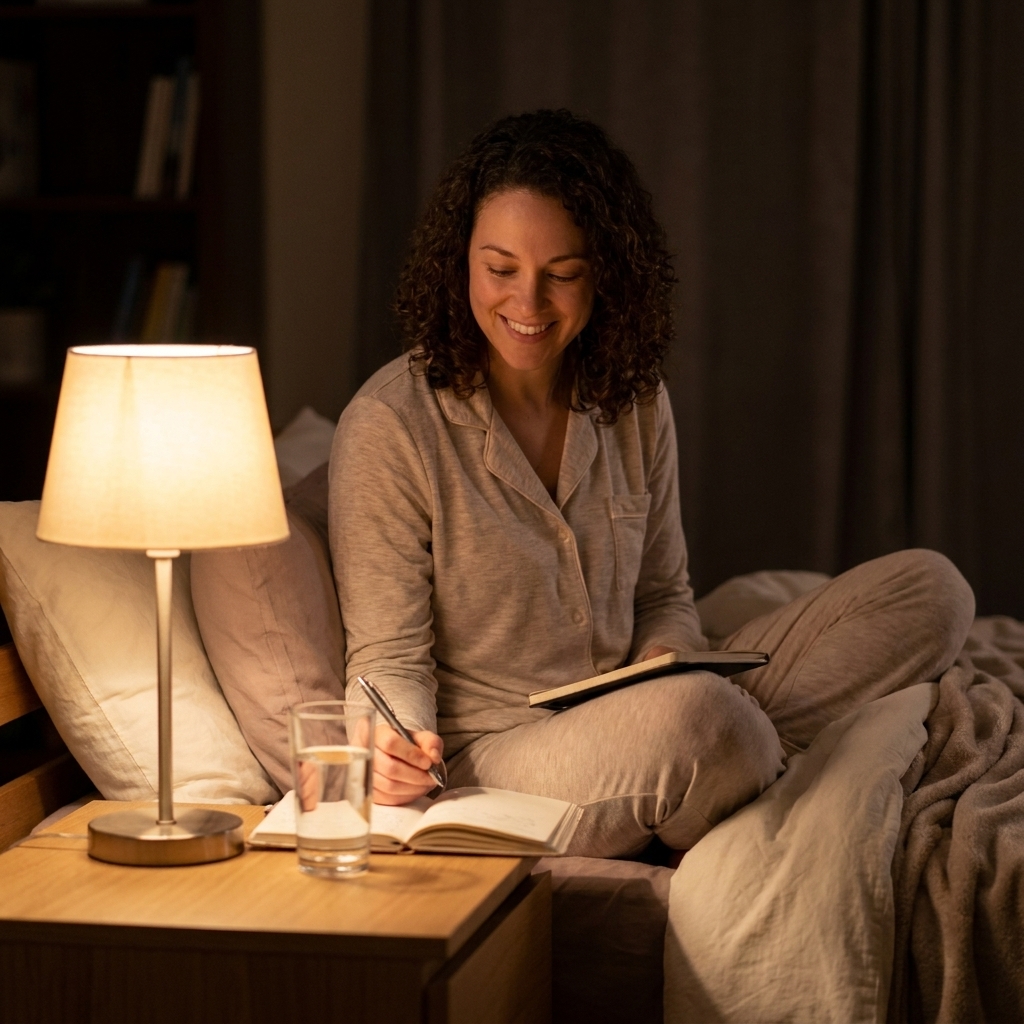
If PMR calms your body but you are still wide awake, do not turn it into a second job. A CBT-I principle called stimulus control can help: if you have been awake long enough that you feel frustrated or alert, get out of bed and do something quiet and boring in dim light until you feel sleepy again, then return to bed. That helps your brain relearn that the bed is for sleep, not for effort.
Safety notes
PMR is generally safe, but a few precautions matter:
- Injury or pain: Avoid tensing any area with a recent injury, surgery, or flare. You can still do PMR by skipping that muscle group and focusing on the release sensation elsewhere.
- Muscle cramping: Use lighter tension and shorter holds.
- TMJ, jaw pain, or headaches: Skip any jaw clenching and use tongue-to-roof-of-mouth or simply soften the lips and cheeks.
- PTSD or panic symptoms: Some people feel uneasy focusing inward in the dark. If that is you, practice PMR during the daytime first, keep a low light on, and consider working with a therapist for tailored approaches.
If your sleep problems are persistent or worsening, or you have signs of another sleep disorder such as loud snoring, breathing pauses, or significant daytime sleepiness, it is worth checking in with a clinician. PMR is a great tool, but it is not a full evaluation.
FAQ
How long does PMR take to help sleep?
Many people feel calmer the first night, but the bigger gains often come with repetition. Give it 1 to 2 weeks of consistent practice to build familiarity and reduce effort.
Is PMR better than deep breathing?
They are different tools. Breathing targets the respiratory system directly. PMR targets muscle tension and can be easier if you feel too activated to control breath rhythm. Many people like combining them by exhaling during the release.
Can I do PMR every night?
Yes. Nightly is fine, and it often becomes more effective as your body learns the sequence.
What if PMR makes me more aware of my body and I get anxious?
Start in the daytime for 3 to 5 minutes, and choose neutral muscle groups first, like hands and forearms. Keep the tension gentle. If symptoms persist, consider switching to a more external focus relaxation method, like listening to a calm audio story.
Start tonight
If you are reading this from bed, here is your simplest next step: tense your shoulders for five seconds, then let them drop on an exhale. Do it one more time. Notice the difference.
That tiny contrast, tension to release, is the whole promise of PMR. It is a skill you can practice on rough nights and ordinary nights alike, until your body starts recognizing bedtime as a place where it is allowed to soften.