A step-by-step, research-driven bedtime routine you can personalize. Learn the key levers that help your brain and body transition into deeper, more consiste...
The Rest Pact
Updated October 18, 2026
Created October 18, 2026
The Ultimate Bedtime Routine

Maya Caldwell
Maya Caldwell is a certified sleep science coach and the lead researcher at RestPact. After overcoming years of chronic insomnia, she dedicated herself to making evidence-based sleep strategies accessible, helping others build bedtime routines that lead to deep, restorative rest.
For most of my 30s, my “bedtime routine” was closing my laptop, brushing my teeth on autopilot, and hoping exhaustion would do the rest. It did, until it didn’t. When your nervous system gets used to running hot all day, your brain does not magically downshift the moment your head hits the pillow.
The good news is that a bedtime routine is not about being perfect or precious. It is a set of repeatable cues that tell your body: we are safe, we are slowing down, sleep is next. Done consistently, those cues can lower pre-sleep arousal and make it easier for your body’s natural sleep biology to do its job, including the normal nighttime shifts in sleep and stress-related hormones.

Below is the step-by-step system I use with coaching clients, with options for different schedules, energy levels, and households. Pick what fits. Repeat it. Let your brain learn the pattern.
Why routines work
Sleep is not a switch. It is a sequence. A strong bedtime routine supports that sequence by nudging three key systems in the right direction:
- Circadian timing: Your internal clock expects predictable cues for when “night” begins. Regular timing makes sleepiness more reliable.
- Sleep pressure: The longer you are awake, the more adenosine builds up, increasing sleep drive. Routines help you avoid accidentally boosting alertness late at night with bright light, intense work, or stressful content.
- Physiologic downshifting: Falling asleep requires a calmer nervous system and a slight drop in core body temperature. Wind-down behaviors, dim light, and certain kinds of warmth can support this transition.
Think of your routine as a landing sequence: lower stimulation, lower light, lower decision-making, and support the body’s natural core cooling as you drift off. Your job is to make sleep the easiest next step.
Step 1: Pick an anchor time
If you only do one thing, do this: pick a realistic wake time you can keep within about an hour most days. For circadian stability, a consistent wake time is often the most powerful anchor, but many people do best when both wake time and bedtime are fairly steady. If you are a shift worker or your schedule rotates, consistency may look different, and the “anchor” may be a consistent routine sequence instead of a consistent clock time.
Then create a “lights-out window,” not a single strict minute. For example: 10:30 to 11:00 pm. Your routine is what gets you into that window.
When to start
A helpful starting point for many adults is 45 to 90 minutes before lights out. If you feel too wired at bedtime, start earlier. If you feel sleepy on the couch then wake up in bed, you likely need a cleaner, more consistent sequence.
Step 2: Use three phases
Here is the structure I recommend because it is easy to remember and flexible to real life:
- Phase A: Close the day (10 to 20 minutes)
- Phase B: Downshift the body (10 to 30 minutes)
- Phase C: Cue sleep (5 to 15 minutes)
Phase A: Close the day
This phase prevents the classic “as soon as I lie down, my brain starts a meeting” problem. You are giving your mind a container so it does not try to solve everything in the dark.
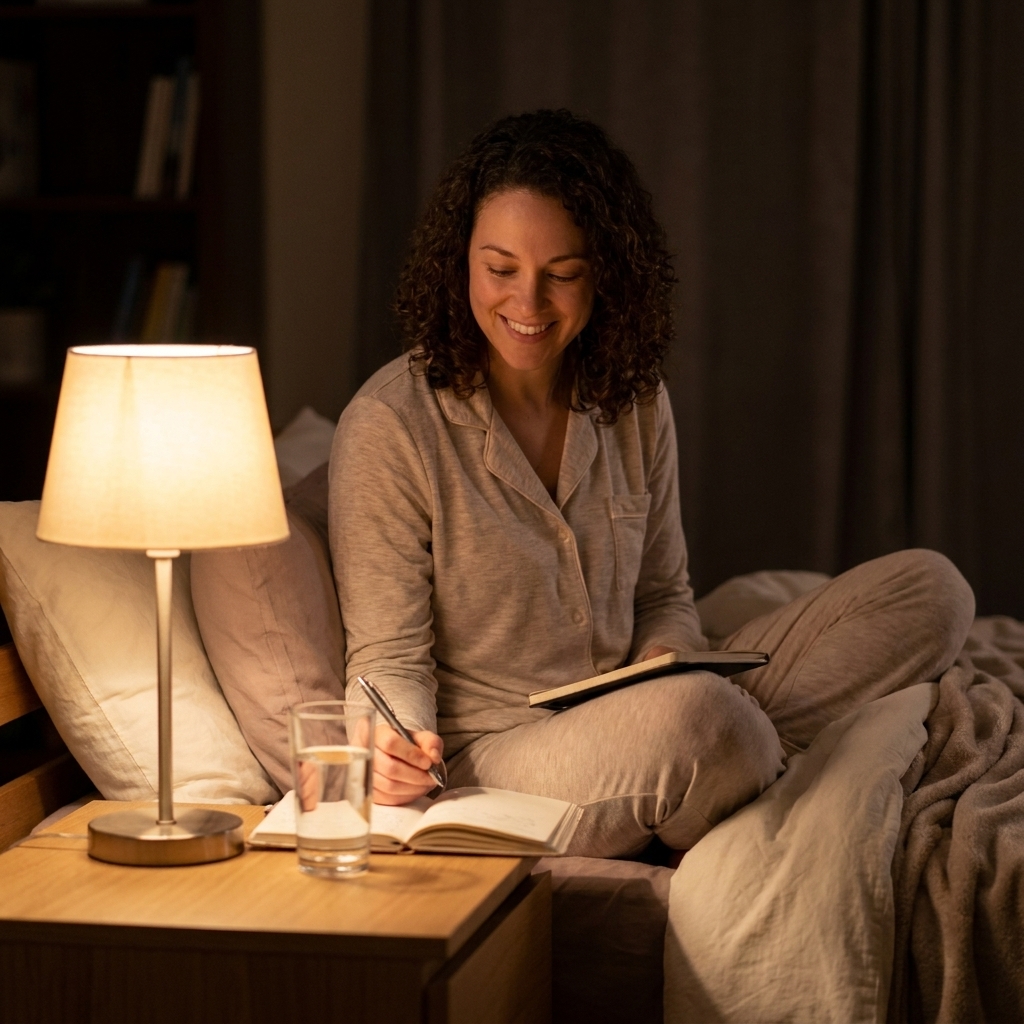
- Two-minute brain dump: Write anything that is looping, even if it is messy.
- Tomorrow list: 3 to 5 bullet points, not a life plan.
- Worry to action: If something is truly urgent, write the next smallest action (email draft, calendar block, question to ask).
If you like structure, keep a notepad by your bed. The goal is not journaling for hours. The goal is closure.
Phase B: Downshift the body
Choose 1 to 3 of these. More is not better. Consistency is better.
- Warm shower or bath: Warming the skin can promote a drop in core body temperature afterward for some people, which can support sleepiness.
- Gentle stretching or yoga: Think soft, not sweaty. Avoid anything that feels like a workout.
- Breathing practice: Try a simple pattern like inhale 4 seconds, exhale 6 seconds for 3 to 5 minutes.
- Progressive muscle relaxation: Tense and release muscle groups from feet to face.
- Chamomile or non-caffeinated tea: Hydrate lightly, but do not overdo it if bathroom trips wake you up.

Phase C: Cue sleep
This is where you reduce cues for alertness and strengthen cues for sleep.
- Dim lights: Use warm, low lighting. Bright light at night can delay melatonin timing for many people.
- Put your phone on a charger outside the bed area: Not moralizing, just reducing friction for late-night scrolling.
- Set the room cool: Many adults sleep best in a slightly cooler room. A commonly comfortable range is roughly 60 to 67°F, but comfort matters most. Aim for “cool enough to want a blanket.”
- Same last step every night: A specific scent, a short passage from a book, a prayer or gratitude line, or a 60-second breathing cue. Your brain learns the ending.
Step 3: Use light and screens
Light is one of the strongest drivers of your circadian rhythm. The goal is not to fear screens. It is to control brightness, distance, and timing.
A simple starting point
- 60 minutes before bed: if you can, avoid bright overhead lighting and intense screen content.
- 30 minutes before bed: if you must use a screen, dim it, use night mode, and keep it farther from your face.
- In bed: ideally, no scrolling. Your bed should mean sleep and intimacy, not inbox and adrenaline.
These are rule-of-thumb guardrails, not magic thresholds. If you work late or have kids, do not panic. Even small changes help. Swapping an overhead kitchen light for a dim lamp can meaningfully change the “daytime” signal your brain is receiving.
Step 4: Block sleep thieves
Caffeine timing
Caffeine has a long half-life, and sensitivity varies a lot. If you are sensitive, even early afternoon coffee can show up at bedtime as a racing mind or lighter sleep. A practical experiment: set a caffeine cutoff of 8 hours before bed for two weeks and see what changes. If you are still wired, you might need 10 to 12 hours. If you tolerate caffeine well, you may not.
Alcohol and 3 am wakeups
Alcohol can make you feel drowsy, but it often fragments sleep later in the night and can worsen snoring and breathing disturbances. If you notice consistent middle-of-the-night wakeups, try shifting drinking earlier, reducing quantity, or building alcohol-free weeknights.
Late heavy meals
Going to bed overly full can increase reflux and discomfort. If you need something before sleep, keep it light and familiar. Think small, simple, and not spicy.
Hard conversations
Some couples only have time to talk once the house is quiet. I get it. If serious topics keep you wired, set “relationship office hours” earlier in the evening or even on a weekend walk. Protect bedtime as a recovery zone.
Naps and late workouts
Naps can be a lifeline, but long or late naps can make it harder to fall asleep at night. If naps affect your bedtime, try keeping them earlier and shorter.
Exercise generally supports sleep, but intense workouts too close to bedtime can be activating for some people. If you notice that pattern, move harder sessions earlier and keep evenings gentler.
Sleep aids and quick fixes
If you are considering over-the-counter sleep aids, be cautious with products that rely on sedating antihistamines. They can leave you groggy, and they do not address the underlying patterns that keep insomnia going. If sleep is a persistent struggle, a clinician can help you choose safer options and a plan that actually holds.
Two routines to copy
The 20-minute minimum
- T minus 20: quick brain dump and tomorrow list (3 minutes)
- T minus 17: wash face, brush teeth, prep clothes or coffee for morning (7 minutes)
- T minus 10: dim lights, phone on charger across the room (2 minutes)
- T minus 8: 4-in, 6-out breathing (3 minutes)
- T minus 5: read paper book or calm e-reader in dim setting (5 minutes)
The 60-minute reset
- T minus 60: close-the-day journaling and tomorrow list (10 minutes)
- T minus 50: warm shower or bath (15 minutes)
- T minus 35: skincare, teeth, set bedroom temperature, lay out tomorrow essentials (10 minutes)
- T minus 25: gentle stretching or legs-up-the-wall (10 minutes)
- T minus 15: dim lights, no email or news (ongoing)
- T minus 10: progressive muscle relaxation in bed (8 to 10 minutes)

Pick one, run it for a week, then adjust. Your routine should feel like relief, not another performance metric.
Step 5: Set up the bedroom
You can have the best routine in the world, but if your sleep environment is loud, bright, hot, or uncomfortable, your brain stays on alert.
High impact checklist
- Light: blackout curtains or a comfortable sleep mask. As a Pacific Northwest resident, I can confirm that light control is sanity.
- Sound: a fan or white noise if you are noise-sensitive, plus earplugs if needed.
- Temperature: keep it cool. Since you mainly control ambient temperature and bedding, experiment until you find “cool enough to want a blanket.” If you overheat, consider breathable bedding or a cooling pillow.
- Comfort: supportive pillow and mattress that match your sleep position. Neck pain is a sleep destroyer.
- Clutter: clear the “to-do” cues from your line of sight. A laundry pile can be surprisingly activating.
Step 6: When sleep will not happen
This matters: the goal is not to force sleep. Forcing sleep teaches your brain that bed is a battleground.
The 20-minute guideline
If you feel awake and frustrated for roughly 15 to 20 minutes, get out of bed and do something quiet in dim light until you feel sleepy again. Choose low-stimulation activities: a boring book, calm music, simple breathing. Then return to bed.
This approach is a core part of CBT-I (cognitive behavioral therapy for insomnia), which has strong evidence for improving insomnia symptoms.
If your bed has become a place where you worry, plan, scroll, and struggle, your brain learns to associate it with wakefulness. Your job is to rebuild the association: bed equals sleep.
When to get help
Most sleep issues improve with consistent basics, but some situations deserve more support. Consider talking to a clinician or a sleep specialist if insomnia lasts more than 3 months, if you have loud snoring, gasping, or choking during sleep, if you feel excessively sleepy during the day, or if you suspect restless legs, panic, depression, or anxiety are driving nighttime wakefulness.
It can also be worth an evaluation if you have multiple sleep apnea risk factors, such as high blood pressure, higher body weight, or a family history, even if you are not sure you snore.
If you want structured, evidence-based help without jumping straight to medication, ask about CBT-I. It is the gold-standard behavioral treatment for insomnia.
Common tweaks
If you are a night owl
Do not suddenly shift bedtime by two hours. Move your schedule in 15 to 30 minute steps every few days. Get bright outdoor light soon after waking, and keep evenings dim.
If you have kids
Your routine might happen in fragments. That is okay. Anchor one consistent “final cue” after the kids are down: dim lights, teeth, two minutes of breathing, then bed. Consistency beats length.
If you work late or shifts
Keep the routine sequence consistent even if the clock time changes: close the day, downshift the body, cue sleep. Also consider a post-shift decompression buffer so you are not trying to sleep directly on top of work stress.
If you wake at night
Keep lights low, avoid checking the time, and use a brief calming skill (slow exhale breathing is a favorite). If you are fully awake, use the same “get out of bed in dim light” strategy rather than tossing and turning.
FAQ
How long should a bedtime routine be?
Long enough to be repeatable. For many adults, 20 to 60 minutes is the sweet spot. If you only have 10 minutes, do a micro-routine: dim lights, hygiene, 2 minutes of breathing, then bed.
What should I do right before bed?
A consistent final cue in a dim, cool environment. Reading a physical book, a brief relaxation practice, or progressive muscle relaxation are all strong options. Avoid anything that spikes emotion or alertness.
Should I stretch before bed?
Gentle stretching can help, especially if it feels soothing. Keep it easy and slow. If stretching turns into a workout, it may backfire by increasing arousal and body temperature.
Is melatonin part of a routine?
Melatonin can be helpful for certain circadian timing issues, but it is not a universal sleep fix. If you are considering it, it is wise to check with a clinician, especially if you are pregnant, trying to conceive, or taking other medications.
Start tonight
If this all feels like a lot, start with one non-negotiable: the last 10 minutes.
- Dim the lights
- Put your phone on a charger out of arm’s reach
- Do 10 slow breaths with longer exhales
- Get into bed at roughly the same time
Do that for seven nights. Then add one more layer. Your nervous system learns through repetition, not intensity. You deserve a routine that feels like kindness at the end of the day.