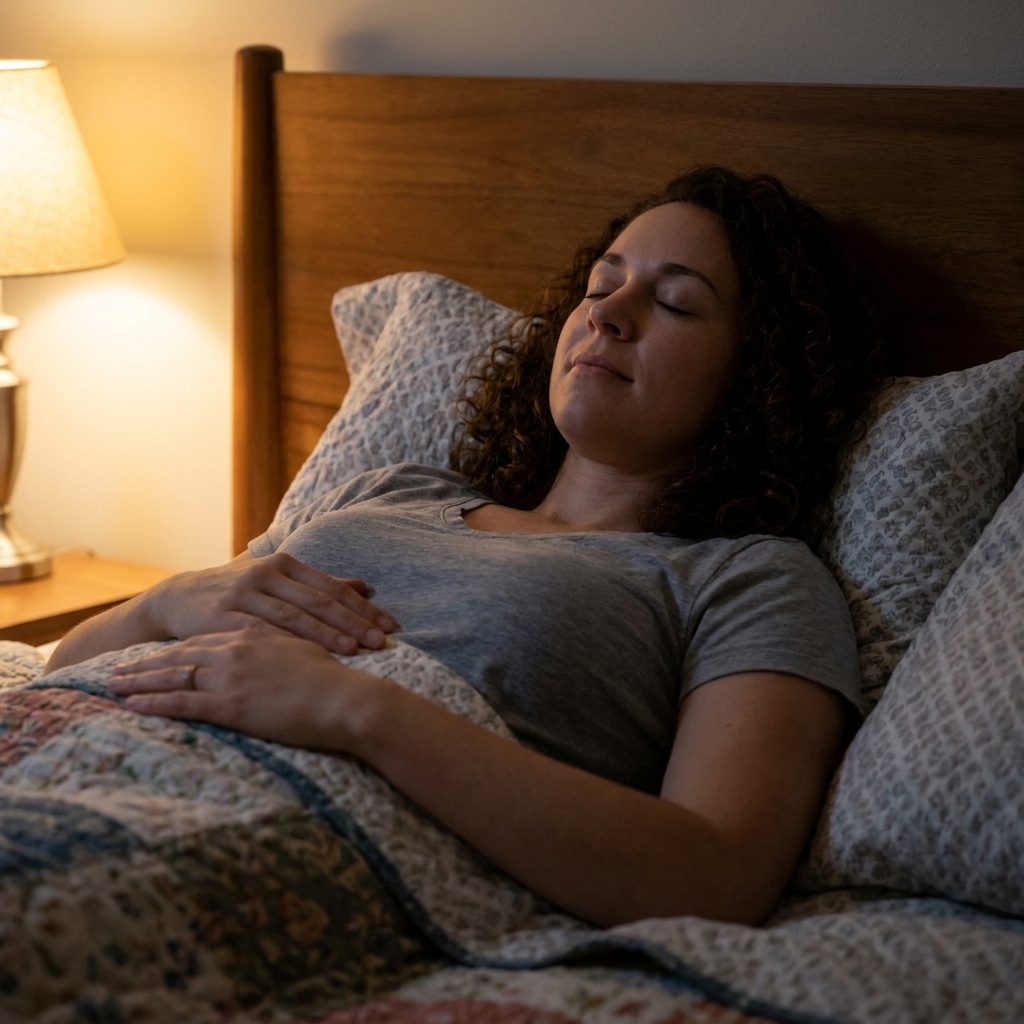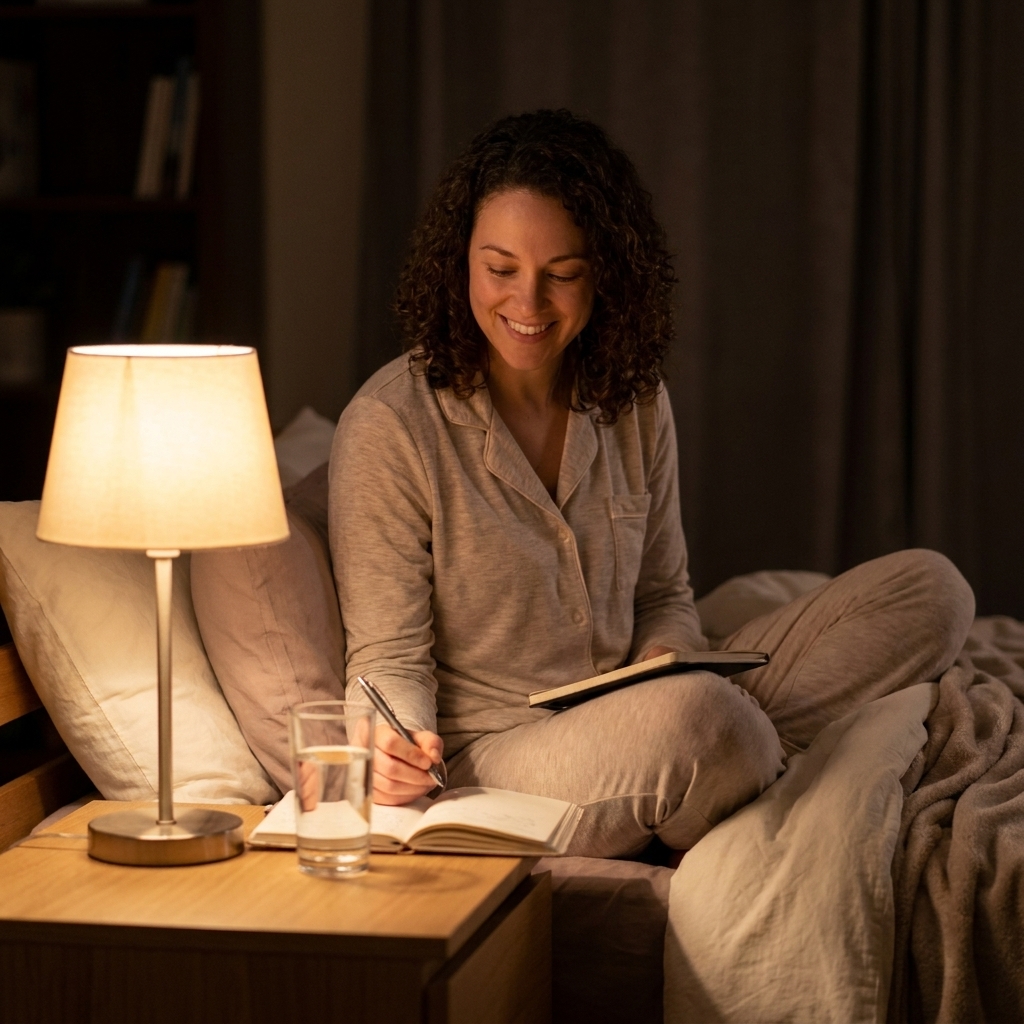
A calm, science-aligned nighttime routine using journaling, breathwork, and mindfulness to slow racing thoughts and make sleep feel possible again.
The Rest Pact
Updated October 18, 2026
Created October 18, 2026
Bedtime Journaling Prompts for Anxiety and Overthinking

Maya Caldwell
Maya Caldwell is a certified sleep science coach and the lead researcher at RestPact. After overcoming years of chronic insomnia, she dedicated herself to making evidence-based sleep strategies accessible, helping others build bedtime routines that lead to deep, restorative rest.
There is a specific kind of tired that comes from being exhausted and still unable to sleep. Your body is ready, but your mind is running tomorrow’s meeting, replaying an awkward conversation from three years ago, and quietly forecasting every possible worst-case scenario.
I lived there for years. As a project manager, I could build a flawless timeline at 11:47 pm, but I could not convince my nervous system that we were safe enough to power down. One of the simplest tools that reliably helped was bedtime journaling, not the “dear diary” kind. The kind that gets thoughts out of your head and onto paper so your brain stops treating them like urgent open tabs.
Below are structured, low-stimulation journaling prompts you can use tonight. No perfection required. The goal is not insight. The goal is relief.
If your anxiety or insomnia is persistent, severe, or escalating, it can help to talk with a clinician. Journaling can be a support, not a substitute for care.

Why journaling can help you sleep
Many people find their minds get louder at night. In the dark and quiet, unresolved tasks and worries can feel bigger than they did at 2:00 pm. Journaling tends to help most when it does two things:
- Externalizes mental clutter so you are not rehearsing it in your head.
- Creates a sense of closure by capturing worries and, when possible, adding a next step.
Some research suggests that brief, structured writing can reduce intrusive thoughts and bedtime cognitive arousal for certain people, especially when it is time-limited and focused. One example is a study in Journal of Experimental Psychology: General (Scullin, Krueger, Ballard, Pruett, 2018) in which writing a to-do list before bed was linked with falling asleep faster than writing about completed activities. The benefit usually comes from consistency and containment: you give your thoughts a place to go, and you give the practice an end time.
Before you start: 3 rules
1) Set a timer (5 to 12 minutes)
If you tend to spiral, a timer is your guardrail. I like 8 minutes for a brain dump, plus 2 minutes for a calming close.
2) Use dim, warm light
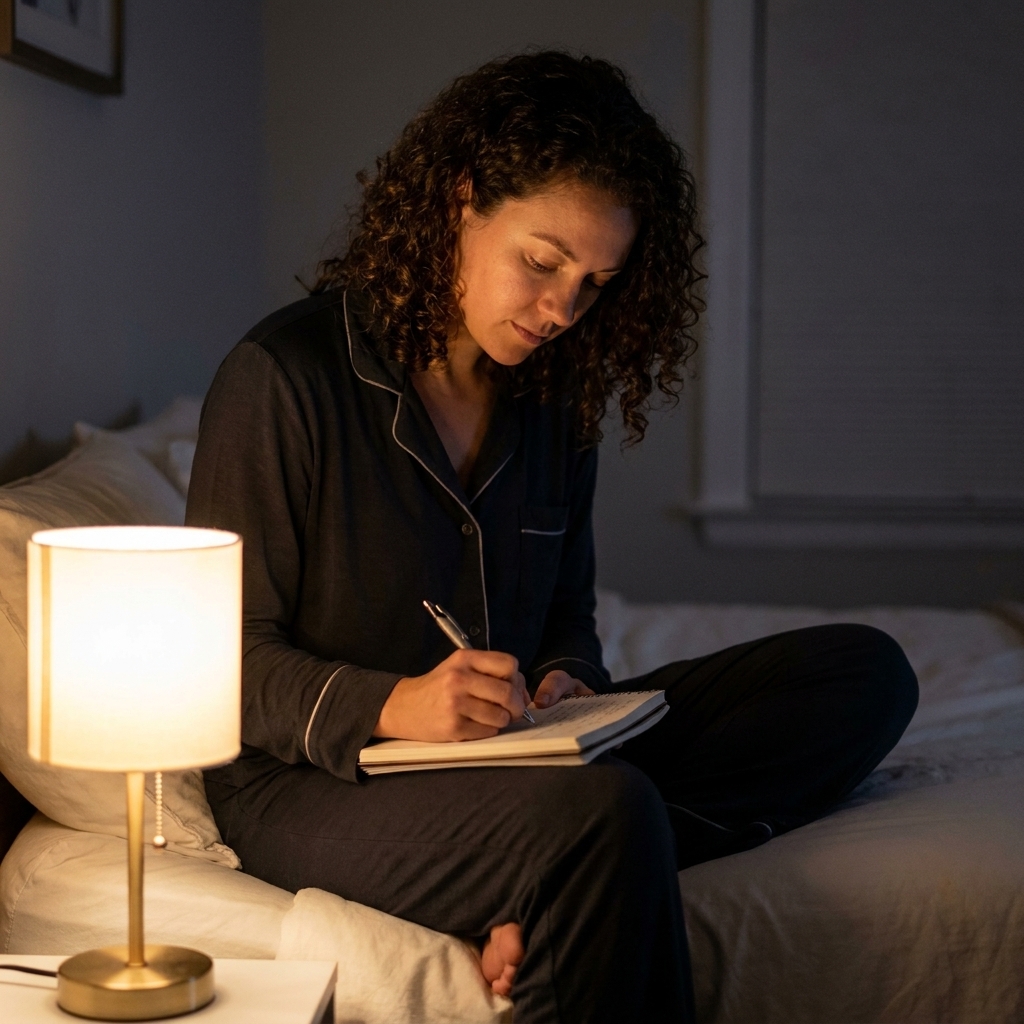
Bright light can signal alertness and “daytime” to your brain. If you can, use a bedside lamp with warm light. (I rely on blackout curtains and a small amber lamp.)
3) End with a closing line
Finish every session with a sentence such as: “This is captured. I can return to it tomorrow.” It sounds simple, but it teaches your brain that the loop is complete.
The brain dump
This is not a gratitude list. Not a vision board. It is a mental inbox sweep.
How to do it
- Set a timer for 5 to 8 minutes.
- Write in fragments if you want. Spelling and grammar do not matter.
- Do not solve anything yet. Just unload.
Brain dump prompts
- “Right now my mind keeps returning to…”
- “The things I am afraid I will forget are…”
- “What feels unfinished today is…”
- “If my brain had a sticky note on it, it would say…”
- “What I keep replaying is…”
- “The 3 loudest thoughts in my head are…”
- “What I wish I could control (but cannot) is…”
- “If I let myself worry freely for two minutes, I worry about…”
Sleep tip: If you notice your writing speeding up and getting more intense, that is a sign to switch to the next section (worry to plan). The goal is release, not escalation.
Worry to plan
Anxiety often spikes at bedtime because your brain is trying to protect you by problem-solving. The problem is that at 12:30 am, problem-solving can turn into catastrophizing.
This exercise respects the brain’s need for a plan while keeping it short and practical. It is also similar in spirit to CBT and CBT-I tools like scheduled “worry time,” where worries get a container rather than unlimited airtime.
The “If it matters, it gets a next step” method
Draw two columns. Label them:
- Worry
- Next step (small)
For each worry, write one next step that takes 5 minutes or less, or one sentence that acknowledges you cannot act tonight.
Prompts for the next-step column
- “The next tiny step is…”
- “Tomorrow at (time), I will…”
- “I need to ask (person) about…”
- “The information I am missing is…”
- “This is not solvable tonight. The earliest time I can work on it is…”
Example: Worry: “I am going to forget to send that email.” Next step: “If I am already at my computer, I will write the first sentence and schedule it for 9:00 am. If not, I will jot one line on a sticky note for tomorrow.”
If your “next step” becomes a 12-step life overhaul, scale it down until it feels almost laughably small. Small is soothing.
Rumination interrupters
Replaying is your brain searching for a better ending. These prompts help you exit the loop without gaslighting yourself.
Prompts that soften replay
- “The story my brain is telling is…”
- “The facts I know for sure are…”
- “What I am assuming is…”
- “If my best friend had done this, I would tell them…”
- “One compassionate alternative explanation is…”
- “What this moment says about my values is…”
- “What I want to remember from this is…”
Optional closing line: “I can learn from this without punishing myself with it.”
Gratitude that calms
Gratitude journaling gets a bad reputation when it becomes performative or forced. For sleep, gratitude tends to work best when it is specific, sensory, and small. You are giving your brain a gentle target that is not threat-related.
Sleep-ready gratitude prompts
- “A small moment that felt safe today was…”
- “Something my body did for me today was…”
- “A sound, smell, or taste I enjoyed today was…”
- “Something that went slightly better than expected was…”
- “A person or pet that made my day easier was…”
- “A problem I handled (even imperfectly) was…”
- “A comfort I am grateful to have access to tonight is…”
Make it concrete: “I’m grateful for my friend” is fine. “I’m grateful for the way my friend texted me ‘I’ve got you’ before my presentation” is soothing.

A 10 minute routine
Minute 0 to 1: Set the container
Write the date. Then write: “I am here to unload my thoughts so my body can rest.”
Minute 1 to 7: Brain dump
Use the brain dump prompts. Do not edit. Do not solve.
Minute 7 to 9: Worry to plan
Pick up to three worries and give each one a next step or a scheduled time to address it tomorrow.
Minute 9 to 10: Gratitude close
Write three small, specific gratitudes. End with: “This is captured. I can return to it tomorrow.”
If you have time, pair this with two minutes of slow breathing in bed. Journaling clears the mind. Breathing tells the body it is safe to sleep.
Theme prompts
If you are anxious about tomorrow
- “The one thing that truly needs my attention tomorrow is…”
- “If tomorrow goes off the rails, my fallback plan is…”
- “The earliest time I can worry productively about this is…”
- “A realistic win tomorrow would be…”
If your mind fixates on health worries
- “What I am noticing in my body is…”
- “What I can do tonight that is supportive (not obsessive) is…”
- “If this is still here in the morning, the next step I will take is…”
- “A time I felt this before and it eased was…”
If you are carrying relationship stress
- “What I wish they understood is…”
- “What I need (that I can ask for respectfully) is…”
- “My boundary in one sentence is…”
- “One thing I can do to care for myself regardless of their response is…”
If you are stuck in perfectionism
- “The version of ‘good enough’ for today is…”
- “What I did finish today is…”
- “If I were 10 percent kinder to myself, I would say…”
- “I can be a whole person without completing…”
Common mistakes
Turning journaling into problem-solving marathons
If your entries read like a strategic plan, your brain stays in work mode. Use the timer, then stop.
Using journaling to relive trauma
Expressive writing can be powerful, but bedtime is not always the safest window for deep processing. If journaling opens up intense feelings that linger, move that work to earlier in the day and consider support from a licensed therapist.
Journaling in bed when your bed feels stressful
If your bed already feels like a battleground, do your journaling in a chair with a soft lamp. Let your bed become the place you sleep, not the place you think.
FAQ
Should I journal in the morning or at night for anxiety?
If your main goal is better sleep, night journaling helps most when it is brief and structured. If journaling tends to stir you up, do the deeper writing in the morning and use a short brain dump at night.
What if I do not know what to write?
Start with: “Right now, I feel…” then finish the sentence three times. Or copy one prompt and answer it with bullet points. Momentum matters more than eloquence.
Is typing on my phone okay?
Paper is often easier for sleep because it avoids bright light and the pull of notifications and other distractions. If typing is your only realistic option, use a notes app with the screen dimmed and airplane mode on, and stop when the timer ends.
How long until journaling helps my sleep?
Some people feel relief the first night. For many, the benefit builds over several days to a couple of weeks as your brain learns that worries get captured and addressed without needing to keep you awake.
What do I do with what I wrote?
In the morning, skim the “next steps” you wrote and choose one small action to complete or schedule. Then close the notebook and move on. The goal is to keep nighttime journaling from becoming an ever-growing worry archive.
A gentle reminder
You do not have to “win” against your thoughts at night. You just need a system that tells your brain: nothing is being ignored, and nothing has to be solved right now.
If you try one thing tonight, make it this: set a timer for 8 minutes, do a brain dump, pick one worry and give it a tiny next step, then write one sensory gratitude. Close the notebook. Turn off the light. Let your nervous system practice standing down.