
A calm, science-aligned nighttime routine using journaling, breathwork, and mindfulness to slow racing thoughts and make sleep feel possible again.
The Rest Pact
Updated October 18, 2026
Created October 18, 2026
Sleep Anxiety and Cognitive Defusion

Maya Caldwell
Maya Caldwell is a certified sleep science coach and the lead researcher at RestPact. After overcoming years of chronic insomnia, she dedicated herself to making evidence-based sleep strategies accessible, helping others build bedtime routines that lead to deep, restorative rest.
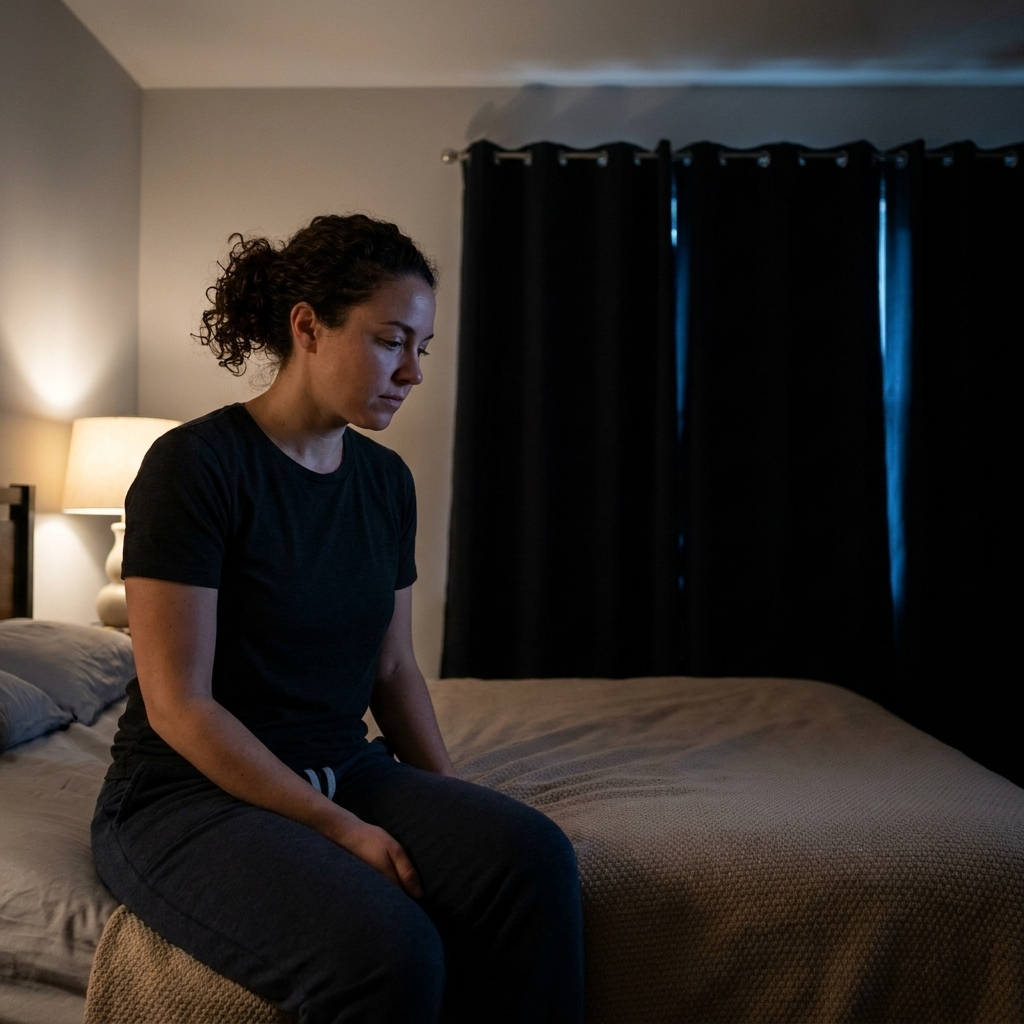
If you have ever stared at the clock and felt your chest tighten as your brain starts calculating tomorrow, you already know what sleep anxiety feels like. It is not just “worry.” It is a specific kind of fear loop: I need to sleep becomes What if I cannot? which becomes Now I am too stressed to sleep.
Here is the frustrating part. The harder you try to force sleep, the more you tend to activate the very systems that keep you awake. Sleep usually arrives most easily when we are not striving for it. Anxiety, on the other hand, is your brain trying to protect you by staying alert. They do not play nicely together.
One of the most effective ways I have found to loosen this loop is a mindfulness-based skill called cognitive defusion. It is a core process in Acceptance and Commitment Therapy (ACT), and it is beautifully practical at bedtime because it does not require you to “fix” or “replace” your thoughts. It teaches you to change your relationship to them.
This article is educational and not medical advice. If you have persistent insomnia or mental health symptoms that feel unmanageable, consider speaking with a licensed clinician.
What it is
Sleep anxiety is your brain treating wakefulness like a threat. You might notice:
- Performance pressure: “I have to fall asleep right now.”
- Catastrophic predictions: “If I do not sleep, tomorrow will be a disaster.”
- Body scanning: monitoring your heart rate, your breathing, your “sleepiness level.”
- Safety behaviors: extending time in bed, trying to “make up for it” with naps, using increasingly complicated rituals or supplements, or rearranging your next day to protect yourself from fatigue.
All of these make sense. They are your nervous system trying to prevent suffering. But at night, they often backfire by increasing arousal.
In behavioral sleep medicine, one common way to explain insomnia is through hyperarousal, meaning your mind and body are running too “on” for sleep to come easily. From a lived-experience perspective, it feels like your mind will not stop working.
Defusion basics
Cognitive defusion means stepping back from thoughts so they are experienced as mental events, not commands or facts. Instead of getting pulled into an argument with your brain at 2:00 a.m., you practice noticing the thought and letting it be there while you return to rest.
Not this
- Positive thinking (trying to swap “bad” thoughts for “good” ones).
- Suppressing thoughts (pushing them away, which can rebound for many people).
- Analyzing your way out (problem-solving insomnia at bedtime).
This
- Naming thoughts as thoughts.
- Creating a bit of distance from scary predictions.
- Letting your body settle even if the mind stays chatty for a while.
I like to say it this way: defusion helps you stop treating your brain like a smoke alarm that must be obeyed, and start treating it like a radio that sometimes plays static.
Worth noting: in ACT, “defusion” usually refers to changing how you relate to thoughts. In this article, when we work with the body, I will call it grounding or anchoring, not defusion, to keep the terms clean.
Why it helps
At night, the goal is not to win a debate with your mind. The goal is to lower arousal enough for sleep pressure and your circadian rhythm to do their jobs. This is one reason clinical guidelines generally recommend Cognitive Behavioral Therapy for Insomnia (CBT-I) as a first-line treatment for chronic insomnia: it targets the habits and cues that keep the system revved up.
When you fuse with a thought like “I will not sleep,” your body can respond as if danger is present: faster heart rate, tighter muscles, shallower breathing, more alertness. Defusion interrupts that escalation by changing the meaning of the thought. It becomes: “I am having the thought that I will not sleep.”
That small shift can reduce the sense of emergency. And when bedtime stops feeling like an emergency, sleep has room to arrive.
7 tools
Choose one or two to practice for a week. The point is not to do them perfectly. The point is repetition, especially on the nights your brain is loud.
1) Add “I am having the thought that”
This is the simplest starting point.
- Fused: “I am not going to sleep.”
- Defused: “I am having the thought that I am not going to sleep.”
Then add a second layer if you want:
- “I notice I am having the thought that I am not going to sleep.”
You are not trying to convince yourself you will sleep. You are labeling the experience accurately.
2) Name the story
Most bedtime anxiety repeats the same few scripts. When you name the script, you reduce its grip.
- “Ah. This is the Tomorrow Will Be Ruined story.”
- “This is the I Need Eight Hours Or Else story.”
- “This is my Something Is Wrong With Me story.”
Then respond gently: “Thanks, mind. I know you are trying to help.”
3) Leaf on a stream
This comes from mindfulness practice and works well if you are visually inclined.
Imagine a slow-moving stream. Each thought goes on a leaf. Your job is not to stop the stream. Your job is to watch the leaf pass without climbing onto it.
If you realize you climbed on, no problem. Step back onto the bank and place the next thought on the next leaf.
4) Sing the thought
This one feels silly, which is precisely why it works. Take the anxious sentence and sing it in your head to something simple.
Example: “I will never fall asleep” becomes a short, absurd jingle.
You are not mocking yourself. You are changing the function of the thought from threat to sound.
If singing feels too activating or self-conscious, try the same idea in a “radio voice,” like a bored announcer reading the sentence over a crackly station.
5) Thank your brain
Bedtime anxiety is often a misguided attempt at prevention. Your mind thinks vigilance will keep you safe tomorrow.
Try: “Thank you, brain. You are trying to protect me. Tonight I am resting anyway.”
This tone matters. Hostility toward your thoughts usually escalates the fight. Warmth de-escalates it.
6) “Not now” scheduling
If the thought is genuinely actionable, bedtime is still the wrong time to handle it.
- “Not now. I will think about this tomorrow at 10:30 a.m.”
Then actually give yourself a short window the next day to write out the plan. This teaches your brain it does not need to ambush you at night to be heard.
7) Drop anchor
Sometimes the mind will not cooperate first. Start with the body.
As you notice a scary thought, do a small release:
- let your jaw unclench
- soften the muscles around your eyes
- drop your shoulders
- let your hands rest open
- let your tongue rest softly (any comfortable position is fine)
Pair it with: “This is a thought. My body can rest anyway.”

10-minute plan
This is the structure I recommend when someone tells me, “I understand the concept, but I need something to do at 1:00 a.m.”
Minute 0 to 2: stop clock-checking
If you can, turn the clock away or put your phone face down out of reach. Clock-checking tends to fuel the threat narrative by constantly updating it.
Minute 2 to 5: label it
Say silently:
- “I am noticing wakefulness.”
- “I am noticing anxiety.”
- “I am having the thought that tomorrow will be terrible.”
Keep it plain and factual.
Minute 5 to 8: choose one tool
Pick one: “name the story,” “leaf on a stream,” or “thank you, brain.” Do it gently, like you are guiding a child back to bed.
Minute 8 to 10: anchor in sensation
Shift attention to a neutral physical anchor:
- the feeling of your pillow under your cheek
- the temperature of the air as you inhale
- the weight of the blanket over your legs
The goal is not to force sleep. The goal is to practice resting without wrestling.
If it is not working
This is common, especially for high-achievers. You try the technique, you still feel anxious, and your brain says: “See? Even this failed.”
Here are a few gentle reality checks:
You may be measuring the wrong thing
Defusion is not a knock-out pill. Early on, success looks like:
- less spiraling
- shorter arguments with your mind
- fewer trips to the clock
- more willingness to rest even while awake
Sleep often follows as a downstream effect.
Your brain will repeat itself
Defusion is not deleting thoughts. It is changing how sticky they are. You may need to defuse the same thought 30 times in a night. That is not failure. That is practice.
Long-running insomnia may need structure
If you have trouble sleeping at least three nights a week for three months or more, that is closer to the clinical pattern of chronic insomnia. At that point, bedtime tools can help, but many people improve fastest with a structured approach such as CBT-I, which clinical guidelines generally recommend as first-line for chronic insomnia.
Habits that help
These skills work best when paired with habits that reduce sabotage.
Keep the bed for sleep
If your bed has become a battleground, your brain learns “bed equals alert.” If you have been awake for a while (often around 20 minutes) and you feel keyed up, consider getting out of bed for a quiet, dim-light activity. Return when sleepy. This is a stimulus control principle used in CBT-I.
Keep wake time steady
A consistent wake time supports circadian alignment and sleep drive, which can make it easier to feel sleepy at night. This matters even after a rough night.
Avoid “try harder” sleep fixes
After a bad night, it is tempting to go to bed early, sleep in, or linger in bed to chase extra minutes. For many people, these moves quietly train the brain that bed is a place to be awake and worried. If you are stuck in this pattern, CBT-I structure can help you unwind it safely.
Reduce clock-driven habits
If you track sleep, consider taking breaks from detailed nightly metrics. For some people, data becomes another performance evaluation.
Use light on purpose
Bright light in the morning, dim light at night. In my Pacific Northwest home, I treat morning light like medicine and blackout curtains like a love language.

Common thoughts
Here are a few examples you can borrow. Read them once now, then return to them when your brain starts bargaining at bedtime.
- Thought: “If I do not fall asleep in 10 minutes, I am done for.”
Defusion: “I am having the urgent thought that I am done for. Urgency is not evidence.” - Thought: “I have to control this or it will spiral.”
Defusion: “There is the control strategy again. I can practice letting this be messy.” - Thought: “Everyone else sleeps normally.”
Defusion: “That is the comparison story. I do not need to solve everyone. I am resting my body.” - Thought: “My heart is pounding. Something is wrong.”
Defusion: “My nervous system is activated. It is uncomfortable, and it can settle.”
Rule out lookalikes
Sometimes “sleep anxiety” is real anxiety, and sometimes it is your body waving a different flag. Consider talking with a clinician if you notice:
- loud snoring, choking or gasping, or significant daytime sleepiness (possible sleep apnea)
- an urge to move the legs at night or creepy-crawly sensations (possible restless legs)
- sleep disruption linked to new medications, nicotine, late-day caffeine, or other stimulants
You do not have to self-diagnose. The point is simply this: if something feels off, it is worth checking.
When to get help
If bedtime anxiety has been going on for months, or if it is affecting your work, mood, or safety, you deserve more than DIY strategies.
Evidence-based treatments like Cognitive Behavioral Therapy for Insomnia (CBT-I) and ACT-informed approaches can be extremely effective. If you also experience panic symptoms, depression, trauma symptoms, or intrusive thoughts that feel unmanageable, a licensed clinician can tailor tools to your situation.
Seek urgent support if you have thoughts of self-harm or feel unsafe.
Quick FAQ
Is defusion the same as restructuring?
No. Cognitive restructuring challenges and changes the content of thoughts. Cognitive defusion changes your relationship to thoughts, even if the content stays the same. Both can be helpful, but defusion is often more bedtime-friendly because it reduces mental effort.
Will it stop thoughts at night?
Not necessarily. The win is that thoughts become less sticky and less activating. Many people still have thoughts, but they stop turning into a full-body alarm.
What if I keep checking the time?
That is extremely common. Treat clock-checking like any other thought-driven behavior: notice the urge, name it (“time-checking urge”), and redirect. If possible, make it harder by turning the clock away or keeping your phone out of reach.
How long does it take?
It varies widely. Some people notice small shifts quickly, like fewer spirals or less dread at bedtime. For many, it is more like building a skill over a few weeks. If insomnia has been entrenched for a long time, structured CBT-I support can make a big difference.
Closing
When I was deep in insomnia, I treated sleep like a test I had to pass. Every bedtime felt like a performance review, and my mind came armed with spreadsheets.
Defusion helped me stop taking every thought personally. It gave me a new option besides fighting: I could notice the fear, make room for it, and still choose rest. That is often when sleep starts to return, not because you forced it, but because you stopped feeding the alarm.
Tonight, if your brain says, “What if I do not sleep?” try answering with something calmer: “Maybe. Maybe not. I can rest either way.”